Posts tonen met het label politics. Alle posts tonen

woensdag 14 december 2011

It's the bet, not the stakes

Robin Hanson wonders why folks have taken offence at Mitt Romney's holding fellow GOP nomination contender Rick Perry*, ** to account by offering a bet: $10k if Perry could prove what he claimed existed in Romney's book. Here's Robin trying to make sense of things:
The idea that a presidential candidate couldn’t afford a $10,000 bet is crazy, as is the idea that ordinary folks don’t know this fact. Candidates pay for TV commercials, which cost lots more than $10,000, and they fly all around the nation in planes, which gets expensive.

So clearly we have moved high up into belief meta-levels here. “Yes, most people know Romney can afford $10,000, but some aren’t sure that most others know this, and so this shows that Romney doesn’t know about such folks.” Or “It is rude to point out that you are rich, even when everyone knows you are rich. Yes wearing nice suits shows he’s rich, but not wearing suits is socially unacceptable. Offering smaller bets is acceptable, however, so offering a big bet could be interpreted as bragging about wealth. Not that I’d interpret it that way, but someone might, and this shows Romney doesn’t realize that.”
I'm not generally one to disagree with Robin, but I think explanations based on voters' having sophisticated conjectural variations models in their heads is a bit of a stretch.

My hypothesis: there'd have been just as much offence taken if he'd offered $100 or $1000 stakes. A non-trivial proportion of statements made in political debates are demonstrably false. They're thrown out in the heat of debate with little chance that the opponent will have ready access to counterevidence; worse, there's risk that bringing up counterevidence moves the debate to where the opponent wants to go anyway. Sure, plenty of online armchair quarterbacking lists all the falsehoods. The candidates never have to front up and answer FactCheck or the news articles. But paying up on a bet is far more humiliating, both for the candidate and his supporters. No partisan wants to witness his idol's humiliation in having to pay up. And so they come up with other reasons for being offended.

If partisanship is more faith-based than fact-based, offering a bet in political debate is akin to going into a Catholic Church with a gas chromatograph in the middle of Mass and offering to bet the priest $10,000 that the wafers are chemically identical before and after purported transubstantiation. The followers might say they're offended about the stakes, even though the Church could back it. But the real problem is nobody wanting to see that their prophets are false.

* Rick Perry's campaign ad, nicely lampooned here, reminded me a lot of the old Dead Milkmen*** song Stuart. Rick Perry's supporters aren't like the other people here in the trailer park - the ones who don't know what the queers are doing to the soil....

** Why hasn't anyone done anything useful RickRolling Rick Perry?

*** First, footnotes in footnotes is cool. Second, the Dead Milkmen are awesome. And "Big Lizard" is the 3-year old's current favourite bedtime song. But I have to Bowdlerize it. And I don't know whether it's better to keep him away from Dead Milkmen 'till he's ready for the proper version, or ease him into it with Bowdlerized versions. Tough problems.

woensdag 30 november 2011

ACT Redux

David Farrar is right: the ACT Party, as it has been, is dead.
ACT have always had two strong components to their brand. On economic issues they were strongly liberal, supporting massive tax cuts, no minimum wage, privatization of all SOEs etc. Those who served with Banks in the National Cabinet say Banks was not a huge supporter of the Richardson camp. He certainly is a fiscal conservative, and centre-right economically. But not someone who would privatize the hospitals.

The other component to the ACT brand has been a degree of social liberalism. This has been patchy rather than consistent, but overall most ACT MPs have been social liberals. John Banks would not describe himself as a social liberal.

Therefore my conclusion is that ACT, as we know it, is dead. There is talk of a name change for ACT, and that would be a sensible move, both because of the different brand John Banks has, but also because the ACT brand itself is pretty tarnished also.

Banks should move to position ACT as a conservative party, which reflects John Banks. Banks would be a good leader of a conservative party. The challenge of course is you also have a Conservative Party led by Colin Craig. And as I understand it, relations between Craig and Banks are not friendly – Craig took many votes off Banks for the Auckland Mayoralty.

A merger between whatever ACT gets re-named and the Conservatives would be a win-win, if they can work together. Craig has the money and the membership base. Banks has the seat in Parliament which means you do not need to make 5%. However just because it is logical does not mean it will happen. Colin Craig doesn’t strike me as someone who would settle for co-leader.

As for ACT itself, my suggestion is that those who identify as economic and social liberals need to have a get together next year and look at who is willing to commit to a new party, perhaps calling it the Liberal Party, and targeting the 2014 election. Many many especially urban younger New Zealanders are classical liberals (even if they have not heard the phrase) and support lower taxes, a smaller state etc but also don’t think Parliament should be greatly restricting what consenting adults can do.

I’m not about to quit the party I support, but I would be prepared to spend quite a bit of time assisting the formation of a new Liberal Party, and making sure lessons are learnt from the mistakes of the past.
Lindsay Mitchell agrees.

I wonder whether Banks' overtures to the Conservatives were designed to push out the remaining liberals. By various online discussion threads, that seems to have been the effect.

I think there's space for a cosmopolitan liberal party grounded more in evidence-based policy than in ideology - pushing liberal policies for which there's sound support - and focused on incremental gains. As a rough cut from the 2008 NZES, there are around 7-8% that would fall into the top quartile of economic liberalism and the top quartile of social liberalism. That's more than are found in the top quartile of economic liberalism and bottom quartile of social liberalism, but still suggests that a Party playing to a hard-core libertarian base would fail.

A party focused as strongly on social freedoms as economic freedoms would have a harder time getting the soft-touch treatment that National has given ACT as it could plausibly go into coalition with Labour. But if it could get over the 5% hurdle, which would involve a massive amount of work with a good chance of failing, it could have reasonable long-term influence relative to a limited set of goals. Advancing economic freedom in coalition with National while preventing some erosions of social liberty, and advancing social liberalism in coalition with Labour/Green while perhaps mitigating the worst of their economic policies, would be an admirable achievement. I'd hoped that this was where Brash would take ACT, back before I figured out what Banks was.

The core enthusiasm and grunt-work for any new Liberal party would have to come from the ranks of the ACT on Campus group and the better parts of their List. But they'll need a few more experienced hands; it's good to hear Farrar's willing to help them out.

Bit of fun: on one of the discussion threads, Peter Cresswell paints me as part of a Gramscean liberal march through the institutions; I suppose I tend to be a bit of a counterhegemonist at the margin. Can there be marginal counterhegemony? Heck, just promoting mainstream economics is sometimes counterhegemonistic [though heads may explode both right and left at the suggestion].

zondag 27 november 2011

Party positions - I don't believe it edition

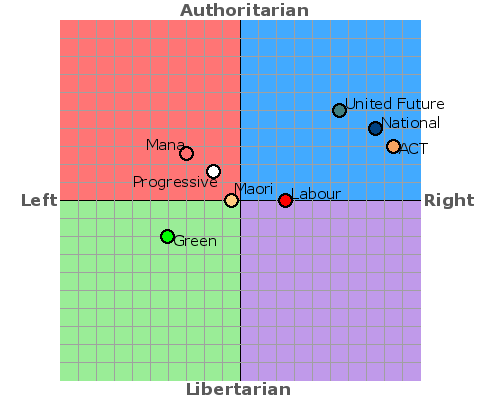
Political Compass placed NZ political parties on a two-dimensional left/right, authoritarian/libertarian chart. (HT: Bryce Edwards)

  1. The left-right economic axis seems about right. It's odd that Labour this year, running on a $15 minimum wage, capital gains tax, and a fairly dirigiste programme, ranked right of centre, but the relative positions seem roughly correct.

  2. The authoritarian-libertarian axis does not seem right. ACT, which mused about marijuana legalization, is ranked more authoritarian than Labour, which would have imposed pretty severe alcohol regulations. ACT is also ranked as more authoritarian than Maori, who seek to ban the sale of tobacco. Many of ACT's candidates were explicitly libertarian. Putting them as more authoritarian than Labour requires putting a fair bit of weight on their crime & punishment stance and mapping views on indigenous rights / individual rights onto a libertarian / authoritarian axis. The party positioning for ACT might be right for the post-election result, with John Banks as the only ACT MP. But not pre-election. Brash was the most libertarian candidate we've had in ages; it's a shame he didn't win in '05 (conditional on his having had an equivalent to Heather Simpson keeping the details in order).

  3. They're right that the Greens aren't tons more socially liberal than Labour. Yes, they take a relatively libertarian position on gay marriage / adoption, copyright, freedom of speech, and marijuana policy. But they also take a relatively authoritarian position on "nanny state" issues. I don't think the Greens, Maori, and ACT aren't as far apart on social liberalism as here made out; those three parties were regularly the ones who voted liberal on social issues in the last couple of Parliaments. 

  4. They correctly place no major party in the right/libertarian quadrant. Even ACT ought only have made it onto the zero line for 2011. This remains a bit puzzling as NZES data shows there are at least as many voters would count as social liberal / fiscal conservative as there are true conservatives. The classical liberals who have supported ACT will have to think hard about whether ACT remains the best vehicle; they know John Banks better than I do.

  5. I wonder where the dot for NZ First would have landed. North-centre?

  6. I wish they would release density maps of survey respondents by country. Sure, it's a self-selected sample. But I'd still be curious how many respondents from NZ wound up in the purple quadrant.

maandag 3 oktober 2011

Public Choice as User Guide

Machiavelli's analysis was both positive and prescriptive: how ought the prince maintain and extend his power? Public Choice has sometimes been accused of being a handbook for would-be despots.

Now, Bueno de Mesquita (HT: @Isegoria) has produced a book that leans more closely to this kind of users-guide: The Dictator's Handbook: Why Bad Behaviour is Almost Always Good Politics. This one's going to the top of my Amazon queue. In the meantime, here's Moynihan's review.

There would probably be a market for an intelligent-layman treatment of all the public choice results on voting and elections written as a guide for candidates and junior politicians.

donderdag 28 juli 2011

Things I learned this afternoon

Fairfax has an awesome infographic on its latest poll results. David Farrar reports Keith Ng's the guy behind it; it's hellacool.

It is impossible to come away from the detailed breakdowns with anything other than thorough admiration for the juggernaut that John Key has built. iPredict's saying 90% likely that he forms the next government; I can't think of anything that's a more sure bet on iPredict; I'm very long and have been for rather a while (1400 shares long National bought at average of $0.76; 1200 short Labour at average of $0.22 but hedged by a few hundred on the Labour Justice Minister contracts that span the Labour space but were much cheaper than buying Labour).

Things that surprised me:
  • National Party support is stronger in Auckland (60%) than on the Mainland (55%). The rural/urban split still kinda holds, but National still has 55% of the urban vote to 62% of the rural.
  • There is NO gender split on support for National. 56% of men and 56% of women support National on the Party Vote. ACT is a sausage-fest (3.6% to 0.7%), but that's not a big surprise. A bigger surprise is that the gender split on the Greens is so small: 6.2% of men and 6.5% of women support the Greens. There is a big skew towards Labour among women, which mostly comes at the expense of ACT, Maori, and NZ First.
  • Green voters are the ones saying they're most likely to move overseas: 3.6% say they'll definitely move overseas for the long term. Sure, NZ isn't as green as the Greens would like. But where is better?!
  • Among those who voted National in '08, 82% say they'd pick John Key as most preferred PM; "don't know" is next on 14. Among those who voted Labour in '08, only 19% say Phil Goff is their preferred PM and 21% say Key. Read that again. More people who voted Labour in '08 prefer John Key as PM than prefer the current Labour Party Leader. 43% of Labour's '08 vote say they don't know who they want as PM. Of those intending to vote Labour this time around, 20% say Goff is the best PM, 46% don't know, and 16% say Key is best.  If this isn't enough to get Labour to knife Goff, I don't know what is. iPredict says only a 10% chance of that happening; I'm going long.

Things that didn't surprise me:
  • National polls best among the 35-59 set: 60% support among that group. But they still have 49% of those under 35 and 55% of those over 60.
  • ACT polls best among those over 60, with 2.9% support there to the 2% in the younger cohorts. Not particularly surprising as ACT has been pushing policies that resonate with social conservatives, alack alas. 6.6% of the oldies like NZ First but nobody under 35 does.
  • Few that voted National in '08 plan to flip to Labour - 4.5%. But 11% of those who voted Labour last time around plan to vote National. Labour is keeping only 79% of those it had in '08; National's keeping 92%. Even the Greens are only keeping 62% - 11% of former Greens are flipping National.
The only interesting question is whether National will govern alone or need a coalition. If it goes coalition, 32% of those saying they'd vote National this time prefer ACT as partner; don't know is next on 25%, then the Greens on  19%. More National supporters prefer a Blue-Green government than prefer a National-United Future government (1.8%) or a National-Maori government (13%).

If there were a button for a National-Green coalition government where Greens got responsibility for copyright and for marijuana law reform, I'd be pushing it. As only 13% of Green supporters prefer coalition with National, they'd then spend three years rending themselves asunder over their supporting National. And, we'd get decent copyright policy as well as a voice for civil liberties.