Posts tonen met het label ACT Party. Alle posts tonen

maandag 26 maart 2012

...they pull me back in

I've been off the youth unemployment file for a few quarters. National's looking like it's done all it's going to do, so it's been on the backburner as other projects demand more attention. ACT's pulling me back in though; their latest press release calling for the reintroduction of a lower youth minimum wage cites one of the numbers from the last post I'd written with those numbers. The NBR picked up the story and asked me for comment; I'll be writing up something a bit more thorough for their weekend edition.

The NBR casts it as ACT having "appropriated" my research; really, I'm exceedingly happy when anybody appropriates anything in my posts so long as there's attribution. It's usually a good idea to drop me a note first to make sure that nothing's been updated or superseded, but I do always hope posts will be "appropriated" somehow or other.*

I'm happy for now to stand by that, subsequent to the changes in youth minimum wages, unemployment outcomes among 16-17 year olds were about 7-8 percentage points higher than we would have expected given prior trends in the youth unemployment rate relative to the adult unemployment rate. In the post from which ACT would have sourced the number, I'd said the table provided:
the expected rate if youth unemployment performance were no worse than in the worst prior quarter relative to the adult unemployment rate.
The 13,100 figure cited is excess youth (15-19 year old) unemployment relative to the trend that prevailed prior to the changes in the youth unemployment rate. I subsequently received more finely grained data from StatsNZ on the age-by-age breakdown; that gave me the 7-8 percentage point figure that's more strictly applicable to the 16-17 year old cohort affected by the most recent legislative change. But we also have the complication that the prior changes affecting 18-19 year olds look to have become binding during the more recent recession.

I'm always reluctant to say "causal". Or at least I try to be. My method is difference-in-difference, so it leers suggestively at causality, but I can't rule out that something else might have happened with the exact same timing that really hit youth unemployment rates relative to adult unemployment rates. I cannot fathom what that "something else" might be, and I think I've ruled out a couple of the potential ones (changes in apprenticeship budgets seem insufficient to explain things), and I'd put money on its being the changes in youth minimum wages. But I can't rule out that it's just my lack of imagination. I do my best to avoid saying "causal" because I can't prove causal.

I'd also caution about getting our hopes up about the speed of any effects coming from a restoration of a lower youth minimum wage. I fully support having a lower minimum wage for youths. But it'll take a while for it to start having real effects. It's faster to kill jobs by hiking the minimum wage than it is to reverse things by lowering it: wages are downwards sticky; employers might be reluctant to hire new kids earning less than very similar kids who'd be sitting next to them the day after a law change. But they might do it a year later.

Anyway, I've asked StatsNZ for the age-by-age breakdowns they'd previously given me, but for the more recent quarters. I'll aim for an updated reckoning for this weekend's NBR.

Had ACT asked me for a usable quote, I'd have said something a bit more nuanced and I'd have cited the 7-8 percentage point figure as likely being due to the prior legislative change.

But ACT is right that letting the youth minimum wage be well below the adult minimum wage is pretty sound policy. The UK gets it: they just last week froze youth minimum wages while mildly increasing adult rates. The adult minimum wage there is £6.19; £4.98 for 18 to 20-year-olds and £3.68 for 16 to 17-year-olds. Double all those numbers to roughly get the New Zealand equivalents: about $12 for adults, $9.67 for 18-20 year olds, and $7.14 for youths. And wonder just a little bit why New Zealand's National Party generally reckons it a good idea to force employers to pay $13 per hour - more than the UK adult minimum wage - for a 16 year old except under exceptional circumstances. And that's going up to $13.50 as of 1 April: £6.96 at current exchange rates. And the NZ New Entrant's rate will be $10.80: £5.56. Less than the UK adult minimum wage rate, but more than their minimum wage for 20 year olds.

* Occasionally I only find out about such appropriations when the University's media monitoring service highlights them. Apparently my suggestion that international students in New Zealand be given permanent residence in New Zealand on graduation made Mike Williams' show on Newstalk ZB earlier this month. Alas, it hasn't seemed to have gotten much traction otherwise.

woensdag 30 november 2011

ACT Redux

David Farrar is right: the ACT Party, as it has been, is dead.
ACT have always had two strong components to their brand. On economic issues they were strongly liberal, supporting massive tax cuts, no minimum wage, privatization of all SOEs etc. Those who served with Banks in the National Cabinet say Banks was not a huge supporter of the Richardson camp. He certainly is a fiscal conservative, and centre-right economically. But not someone who would privatize the hospitals.

The other component to the ACT brand has been a degree of social liberalism. This has been patchy rather than consistent, but overall most ACT MPs have been social liberals. John Banks would not describe himself as a social liberal.

Therefore my conclusion is that ACT, as we know it, is dead. There is talk of a name change for ACT, and that would be a sensible move, both because of the different brand John Banks has, but also because the ACT brand itself is pretty tarnished also.

Banks should move to position ACT as a conservative party, which reflects John Banks. Banks would be a good leader of a conservative party. The challenge of course is you also have a Conservative Party led by Colin Craig. And as I understand it, relations between Craig and Banks are not friendly – Craig took many votes off Banks for the Auckland Mayoralty.

A merger between whatever ACT gets re-named and the Conservatives would be a win-win, if they can work together. Craig has the money and the membership base. Banks has the seat in Parliament which means you do not need to make 5%. However just because it is logical does not mean it will happen. Colin Craig doesn’t strike me as someone who would settle for co-leader.

As for ACT itself, my suggestion is that those who identify as economic and social liberals need to have a get together next year and look at who is willing to commit to a new party, perhaps calling it the Liberal Party, and targeting the 2014 election. Many many especially urban younger New Zealanders are classical liberals (even if they have not heard the phrase) and support lower taxes, a smaller state etc but also don’t think Parliament should be greatly restricting what consenting adults can do.

I’m not about to quit the party I support, but I would be prepared to spend quite a bit of time assisting the formation of a new Liberal Party, and making sure lessons are learnt from the mistakes of the past.
Lindsay Mitchell agrees.

I wonder whether Banks' overtures to the Conservatives were designed to push out the remaining liberals. By various online discussion threads, that seems to have been the effect.

I think there's space for a cosmopolitan liberal party grounded more in evidence-based policy than in ideology - pushing liberal policies for which there's sound support - and focused on incremental gains. As a rough cut from the 2008 NZES, there are around 7-8% that would fall into the top quartile of economic liberalism and the top quartile of social liberalism. That's more than are found in the top quartile of economic liberalism and bottom quartile of social liberalism, but still suggests that a Party playing to a hard-core libertarian base would fail.

A party focused as strongly on social freedoms as economic freedoms would have a harder time getting the soft-touch treatment that National has given ACT as it could plausibly go into coalition with Labour. But if it could get over the 5% hurdle, which would involve a massive amount of work with a good chance of failing, it could have reasonable long-term influence relative to a limited set of goals. Advancing economic freedom in coalition with National while preventing some erosions of social liberty, and advancing social liberalism in coalition with Labour/Green while perhaps mitigating the worst of their economic policies, would be an admirable achievement. I'd hoped that this was where Brash would take ACT, back before I figured out what Banks was.

The core enthusiasm and grunt-work for any new Liberal party would have to come from the ranks of the ACT on Campus group and the better parts of their List. But they'll need a few more experienced hands; it's good to hear Farrar's willing to help them out.

Bit of fun: on one of the discussion threads, Peter Cresswell paints me as part of a Gramscean liberal march through the institutions; I suppose I tend to be a bit of a counterhegemonist at the margin. Can there be marginal counterhegemony? Heck, just promoting mainstream economics is sometimes counterhegemonistic [though heads may explode both right and left at the suggestion].

zondag 27 november 2011

Party positions - I don't believe it edition

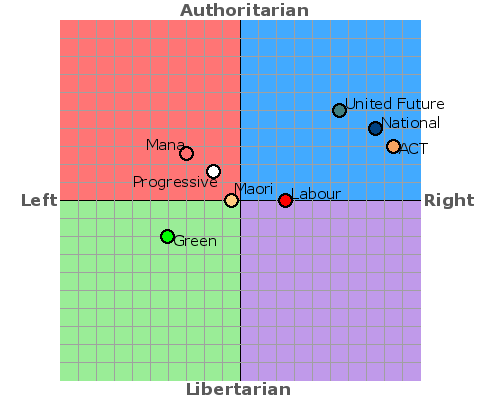
Political Compass placed NZ political parties on a two-dimensional left/right, authoritarian/libertarian chart. (HT: Bryce Edwards)

  1. The left-right economic axis seems about right. It's odd that Labour this year, running on a $15 minimum wage, capital gains tax, and a fairly dirigiste programme, ranked right of centre, but the relative positions seem roughly correct.

  2. The authoritarian-libertarian axis does not seem right. ACT, which mused about marijuana legalization, is ranked more authoritarian than Labour, which would have imposed pretty severe alcohol regulations. ACT is also ranked as more authoritarian than Maori, who seek to ban the sale of tobacco. Many of ACT's candidates were explicitly libertarian. Putting them as more authoritarian than Labour requires putting a fair bit of weight on their crime & punishment stance and mapping views on indigenous rights / individual rights onto a libertarian / authoritarian axis. The party positioning for ACT might be right for the post-election result, with John Banks as the only ACT MP. But not pre-election. Brash was the most libertarian candidate we've had in ages; it's a shame he didn't win in '05 (conditional on his having had an equivalent to Heather Simpson keeping the details in order).

  3. They're right that the Greens aren't tons more socially liberal than Labour. Yes, they take a relatively libertarian position on gay marriage / adoption, copyright, freedom of speech, and marijuana policy. But they also take a relatively authoritarian position on "nanny state" issues. I don't think the Greens, Maori, and ACT aren't as far apart on social liberalism as here made out; those three parties were regularly the ones who voted liberal on social issues in the last couple of Parliaments. 

  4. They correctly place no major party in the right/libertarian quadrant. Even ACT ought only have made it onto the zero line for 2011. This remains a bit puzzling as NZES data shows there are at least as many voters would count as social liberal / fiscal conservative as there are true conservatives. The classical liberals who have supported ACT will have to think hard about whether ACT remains the best vehicle; they know John Banks better than I do.

  5. I wonder where the dot for NZ First would have landed. North-centre?

  6. I wish they would release density maps of survey respondents by country. Sure, it's a self-selected sample. But I'd still be curious how many respondents from NZ wound up in the purple quadrant.

zondag 25 september 2011

Shambolic

What a shambolic disappointment.

I've argued that ACT would do best to return to its classical liberal roots - that there's an unserviced space that's relatively liberal on economic and on social issues. As a right-wing rump to National, more liberal on economics but conservative on social issues, they'd be bound in the spot occupied by the Greens on the left - forever taken for granted by the dominant coalition partner because they couldn't plausibly bring down the government in favour of a coalition led by the main party on the other side. And, I've also thought that staking out a position on marijuana legalization could be a good way of signalling a move to that space. It would confound the usual narrative dominated by right-left thinking and, in so doing, bring a lot of positive press for ACT as it moves into a different space.

So I was really pleased to hear Don Brash musing about marijuana decriminalization over the weekend. Sure, decriminalization hardly goes far enough: if the trade remains illegal but possession legal, production remains split between informal household production among those into gardening, friendly informal supply among friends (albeit with risk that comes with growing more plants than is needed for personal use), and the gangs. Cactus Kate is right: full legalization is better.

In a fully legal and regulated market, we could move to supply under conditions similar to alcohol regulation with age controls and excise taxation to internalize whatever minor external harms come from marijuana use; alternatively, a higher than economically optimal tax could be set if necessary to build the coalition to move from prohibition to legalization - keeping retail price roughly constant but with the deadweight losses of the informal market turned into tax revenues. I've ballparked potential excise revenues at around $100-$300 million if taxes were set to hold consumer prices constant across regime change; actual figures would depend on potential economies of scale in production in a legalized market. If we were to take the $116 million spent by police on marijuana busts and instead devote it to violent crime, we could expect social cost savings on the order of about $275 million.

I'd thought that Brash's trial balloon was floated with his having secured at least minimal support from the Party apparatus. And so I was really optimistic - he had sold the party on a move towards liberalism despite John Banks being the candidate in Epsom. Alas, I must have been smoking something.

In a speech on law and order to party supporters in Auckland yesterday, Brash said he had serious questions about New Zealand's current marijuana laws and gave his personal endorsement to at least a debate over cannabis law reform.
However ACT president Chris Simmons today said decriminalising the class-C drug wouldn't be the party's policy next year, in 2014 or even 2017.
Simmons said the party's board wouldn't support decriminalisation, which was a "step too far." But he said it was important for party members to be asking questions and raising new ideas.
John Banks, the party's Epsom candidate and a former police minister, today said he could not support cannabis decriminalisation.
The party is polling well below the 5 per cent threshold to be guaranteed seats in Parliament, and is expected to depend on Banks winning Epsom.
This weekend also brought the shock resignation of parliamentary leader John Boscawen. Boscawen insisted he wasn't quitting over Brash's speech, but because he wanted to spend more time with his family. He made his decision on Friday.
He said his ''personal views'' on drug law reform weren't important but the issue should be debated, especially the $100m cost to the taxpayer of enforcing the laws. Decriminalisation wasn't ACT policy, he stressed.

Brash tried to pull the Party to the liberal side - a move that makes sense, but is hard given ACT's starting point. It wasn't made easier by that a bunch of people who claim to support marijuana decriminalization started piling on making fun of Brash's policy move. Yeah, you know who you are. It's all hip to make fun of the 70-year-old who's obviously hardly come within smelling distance of pot and pretend that he's a dope-head for advocating policy change. But, as best I understand things, it's that fear of being labelled "the marijuana guy" that effectively stopped Rodney Hide from pushing for greater consideration of the Law Commission's recommendations on marijuana. If the result of pushing for rational policy discussion is to be made a laughingstock even by those who purport to support rational policy, it ain't hard to figure out the likely effect on the supply of rational policy discussion.

The issue's now dead. And ACT probably is too. They could have staked out a defensible position in liberal space. But the conservative side has won. Worse, the party comes out as incoherent on core guiding principles: ACT is the party where economic liberals who are socially conservative get to fight publicly with economic liberals who are socially liberal. And whether or not Banks gets Epsom, that likely dooms the party in the long run.

Meanwhile, the online poll at newspaper site Stuff.co.nz has support for decriminalization ahead at 73% in favour to 27% against.

I really really wish that the NZES folks would include some questions about marijuana law in their 2011 survey. There's no way that the politicians will lead public opinion on this one, but there's good chance they'd follow. If even the pundits who agree with legalization make fun of the politicians who support it, no chance of any kind of policy move until there's obvious public support.

dinsdag 28 juni 2011

A mild clarification

I like the ACT Party's campaign to reinstate a lower youth minimum wage. Their ad over the weekend cited some of my numbers, though, and I'd want a footnote on there. They write:
Economist Eric Crampton estimates that Labour's abolition of the youth wage has cost 12,350 young people jobs.
I'd be more comfortable saying that the abolition of the youth wage has most likely cost between eight and twelve thousand jobs. The numbers since mid 2009 have ranged from about seven thousand to about thirteen thousand more kids unemployed than we'd expect given the adult unemployment rate. 12,350 is the number that drops out of the last quarter, but StatsNZ warned about data problems with that quarter's HLFS given data collection problems in Canterbury.

The "most likely" matters too as I don't have a design that allows for strong causal statements. I'd put 20:1 that youth minimum wage increases are to blame for current excess youth unemployment, but it's always possible that something else did it. Something else that affected kids (and not adults) and that hit with the right timing and that has a good body of theory predicting such an effect and that would have been large enough to have had that effect. I can't think of what else meets the bill, but maybe I'm unimaginative.