Posts tonen met het label ideology. Alle posts tonen

woensdag 21 maart 2012

Dogmatism and memory constraints

Jeff Ely shows how dogmatism can be the consequence rather than the circumvention of rational thinking. We may process information rationally, arrive at a position, discard the workings that got us to the position to save memory space, then move on to the next area for rational deliberation.
So what you optimally, rationally, perfectly objectively do is allow yourself to forget everything you know about A including all the reasons that justify your strongly-held views on A and to just make an indelible mental note that “The right-wing position on A is the correct one no matter what anyone else says and no matter what evidence to the contrary should come along in the future.”
The reason this is the rational thing to do is that you have scarce memory space. By allowing those memories to fade away you free up storage space for information about issues B, C, and D which you are still carefully collecting information on, forming an objective opinion about, in preparation for eventually also adopting a well-informed dogmatic opinion about.
I do this all the time. It's actually one of the reasons I blog: to keep track, in easily searchable and keyword-indexed format, of the reasons that led me to hold positions. It's surprising how often I've found myself searching back through the archive to remind myself of what I'd concluded about something, and how often I curse myself for having arrived at some position before I started blogging.

But I do enjoy that rather a few of you come along for the ride.

HT: @Nonicoc

zondag 27 november 2011

Party positions - I don't believe it edition

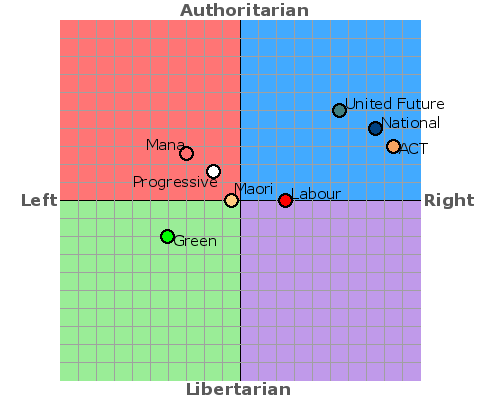
Political Compass placed NZ political parties on a two-dimensional left/right, authoritarian/libertarian chart. (HT: Bryce Edwards)

  1. The left-right economic axis seems about right. It's odd that Labour this year, running on a $15 minimum wage, capital gains tax, and a fairly dirigiste programme, ranked right of centre, but the relative positions seem roughly correct.

  2. The authoritarian-libertarian axis does not seem right. ACT, which mused about marijuana legalization, is ranked more authoritarian than Labour, which would have imposed pretty severe alcohol regulations. ACT is also ranked as more authoritarian than Maori, who seek to ban the sale of tobacco. Many of ACT's candidates were explicitly libertarian. Putting them as more authoritarian than Labour requires putting a fair bit of weight on their crime & punishment stance and mapping views on indigenous rights / individual rights onto a libertarian / authoritarian axis. The party positioning for ACT might be right for the post-election result, with John Banks as the only ACT MP. But not pre-election. Brash was the most libertarian candidate we've had in ages; it's a shame he didn't win in '05 (conditional on his having had an equivalent to Heather Simpson keeping the details in order).

  3. They're right that the Greens aren't tons more socially liberal than Labour. Yes, they take a relatively libertarian position on gay marriage / adoption, copyright, freedom of speech, and marijuana policy. But they also take a relatively authoritarian position on "nanny state" issues. I don't think the Greens, Maori, and ACT aren't as far apart on social liberalism as here made out; those three parties were regularly the ones who voted liberal on social issues in the last couple of Parliaments. 

  4. They correctly place no major party in the right/libertarian quadrant. Even ACT ought only have made it onto the zero line for 2011. This remains a bit puzzling as NZES data shows there are at least as many voters would count as social liberal / fiscal conservative as there are true conservatives. The classical liberals who have supported ACT will have to think hard about whether ACT remains the best vehicle; they know John Banks better than I do.

  5. I wonder where the dot for NZ First would have landed. North-centre?

  6. I wish they would release density maps of survey respondents by country. Sure, it's a self-selected sample. But I'd still be curious how many respondents from NZ wound up in the purple quadrant.