Posts tonen met het label alcohol. Alle posts tonen

dinsdag 17 april 2012

Correlation, causation, and alcohol

It isn't hard to find studies linking heavy alcohol use to bad social outcomes; it's harder to find ones that adequately correct for individual risk-seeking behaviour.

A few relevant bits of news this past week.

Teenagers who drink are more likely to have played the "choking game". Now I'll take this one with a fair bit of scepticism; it isn't hard to imagine that a fair number of the 6% of Oregon eighth-graders who reported that they enjoy asphyxiation might just have been messing around with the survey team. It's the kind of thing I'd have thought was fun as an eighth-grader. But, here's the alcohol connection:
His team's findings are based on a 2009 survey given to more than 5,000 Oregon eighth graders. The researchers found that kids who were sexually active and those who used drugs or alcohol were more likely to have played the choking game.
At least nobody seems to be claiming that alcohol use is a gateway drug to asphyxiation play.

Second bit of news: a French study shows people with more tattoos drink more alcohol.

People with tattoos drink more than their tattoo-less peers, a new study from France suggests.
The researchers asked nearly 3,000 young men and women as they were exiting bars on a Saturday night if they would take a breathalyzer test. Of those who agreed to take it, the researchers found that people with tattoos had consumed more alcohol than those without tattoos, the researchers said.
Previous studies have shown that tattooed individuals are more likely to engage in risky behaviors, such as unprotected sex, theft, violence and alcohol consumption, compared to people without tattoos.
The researchers suggest educators, parents and physicians consider tattoos and piercings as potential "markers" of drinking, using them to begin a conversation about alcohol consumption and other risky behaviors.
Again, nobody seems to be claiming that alcohol's a gateway drug to getting tattoos. Both of these point to underlying risk-preference as driving outcomes.

Finally, this one points to a more causal relationship. I'm not sure that causality is all that strongly established, but here's the abstract via Bakadesuyo:
A within-person multilevel approach was used to model the links between alcohol use and sexual behavior among first-year college students, using up to 14 days of data for each person with occasions (Level 1, N = 2879 days) nested within people (Level 2, N = 218 people; 51.4% male). Between-persons (Level 2) effects were gender, relationship status, person means of alcohol use, and alcohol-sex expectancies for sexual affect and sexual drive. Within-person (Level 1) effects were weekend days, number of drinks consumed, and the interaction between drinks consumed and alcohol-sex expectancies. Independent of average alcohol use, consuming more drinks on a given day was associated with a greater likelihood of oral sex and with experiencing more positive consequences of sex that day. Significant Alcohol Use × Alcohol-Sex Expectancies interactions were found for oral sex and total sex behaviors, indicating that individuals with more positive expectancies were more likely to have sex after drinking. The negative association between drinks and condom use was at a trend level of significance. Results support the potential for promoting sexual health by focusing on cross-behavior expectancies among late adolescents.
The full paper is here. I still wonder whether the within-person design isn't picking up that the same person will behave differently when going out "for a good time" than he or she would on average otherwise. But, the paper at least suggests that if we're worried about an "alcohol leads to more sex" relationship, we should just maybe put some weight on that this might not be a bad thing on average.

We might also note that there's some evidence that reported correlations between drinking and risky sexual activity are driven by underlying risk preference as well. The linked paper finds that people who use condoms when sober also use them when drinking, and that those who don't when sober, don't when drinking. The researchers there also worry that extensive public warnings about that heavy drinking leading to risky sex may well prime people to do exactly that:
Based on a critical review of this literature, we conclude that it is imprecise (and even misleading) to disseminate the message that alcohol leads to sexual risk behavior. Other authors (Bolton et al., 1992) have noted that if there is no association at the event-level (and therefore no causal association) then disseminating this message may have the effect of giving people an excuse to engage in risk behavior when drinking. This idea is plausible, especially when expectancy theory is taken into account. Because alcohol expectancies can be acquired from a variety of sources other than personal experience (Goldman et al. 1999), delivering a message that alcohol use proximal to sexual activity causes riskier sexual behavior may have the effect of “teaching” sex-related alcohol expectancies to intervention participants who may not have previously held them, and may reinforce expectancies in other participants.
I worry about this too. There's pretty wide variation across countries in how people behave after drinking. Breaking the expectation that drinking gives you an excuse to do dumb things might be more important than reducing drinking. Alcohol use should be something that adds to the probability of being charged and punished when committing offences rather than being exculpatory.

donderdag 15 maart 2012

Obesity and Impulsivity

Blaming the victim, perhaps. But a new paper suggests personality traits correlate strongly with obesity outcomes. [HT: @bakadesuyo] They find very strong correlations between neuroticism and obesity, and between low conscientiousness and obesity, concluding:
Obesity is a major public health crisis that has multiple antecedents. Certainly many factors, other than psychological, have contributed to the recent societal increase in weight. Yet, even after controlling for major demographic and genetic risk factors, personality traits remain significant predictors of adiposity (Chapman et al., 2009; Terracciano et al., 2009). In fact, personality has an effect on BMI that is of similar or greater magnitude than that of socioeconomic status (Chapman et al., 2009) or the FTO-variant (Terracciano et al., 2009). The cognitive, emotional, and behavioral patterns associated with personality traits likely contribute to unhealthy weight and difficulties with weight management. Identifying the personality traits associated with obesity may help to elucidate the role of personality traits in disease progression.
My first worry is that being obese may generate measures of neuroticism (anger, for starters); fatalism consequent to poor obesity outcomes also could generate low conscientiousness. In other words, it's then hard to exclude reverse causation. But, they also run a few tests on whether personality traits predict weight gain, finding:
In the HLM analyses, the emotional aspects of impulsivity—N5: Impulsiveness and E5: Excitement-Seeking—were consistently associated with greater weight gain over time across the four measures of adiposity. Such individuals give in to temptation and seek out highly stimulating environments; food and alcohol may be one form of stimulation. And, in fact, sensation seeking has been linked with binge drinking (McAdams & Donnellan, 2009) and overeating (Davis et al., 2007). Such behavior may, over time, contribute to weight gain.
I worry that nudge or harder paternalistic measures targeting specific outcomes like obesity, or drinking, or whatever manifestation of high impulsivity/low conscientiousness you want to get angry about, wind up having perverse consequence by effectively subsidizing failure to invest in the general purpose personal technology of impulsivity control and conscientiousness.

Want to fight obesity and other bad stuff in the longer term? Come up with a good way of training kids in conscientiousness and impulse control.

vrijdag 24 februari 2012

Confounds, alcohol and violence

It's plausible that increased alcohol consumption in a neighbourhood directly affects assault rates. But I don't think you can tell it from this study (HT: Bakadesuyo).

Methods and Findings

We performed a population-based case-crossover analysis of all persons aged 13 years and older hospitalized for assault in Ontario from 1 April 2002 to 1 December 2004. On the day prior to each assault case's hospitalization, the volume of alcohol sold at the store in closest proximity to the victim's home was compared to the volume of alcohol sold at the same store 7 d earlier. Conditional logistic regression analysis was used to determine the associated relative risk (RR) of assault per 1,000 l higher daily sales of alcohol. Of the 3,212 persons admitted to hospital for assault, nearly 25% were between the ages of 13 and 20 y, and 83% were male. A total of 1,150 assaults (36%) involved the use of a sharp or blunt weapon, and 1,532 (48%) arose during an unarmed brawl or fight. For every 1,000 l more of alcohol sold per store per day, the relative risk of being hospitalized for assault was 1.13 (95% confidence interval [CI] 1.02–1.26). The risk was accentuated for males (1.18, 95% CI 1.05–1.33), youth aged 13 to 20 y (1.21, 95% CI 0.99–1.46), and those in urban areas (1.19, 95% CI 1.06–1.35).
What's the problem? They don't seem to be controlling for day-level fixed effects or, even better, day-city fixed effects. Suppose there's a big hockey game on Saturday night that both brings a pile of folks onto the street and increases alcohol purchases. You can get a correlation between increased alcohol sales (relative to the week prior) and assaults entirely as artefact of the underlying variable driving both assaults and alcohol sales. A big hockey game, a holiday long weekend, even a big concert in town - none of those are addressed by comparing alcohol sales with those a week prior.

How do you fix this? Controlling for simultaneous alcohol sales in a similar part of town that's far enough away that it's unlikely to have had effects on the part of town in question would be a start, but might not catch localized effects of events that drive both alcohol sales and violence.

vrijdag 10 februari 2012

Oh not another one

UK Parliamentarians are throwing around aggregate social cost figures mostly consisting of costs borne by drinkers as representing costs to British taxpayers of harmful drinking. Nanny state Labourites? Nope. A Tory. Read the excellent Chris Snowdon for the details.*

This is the corruption that comes of social cost studies that disguise private costs as publicly borne unless you check their work more carefully than any journalist or parliamentarian ever will.

* I'll quibble with Chris on a couple minor points. Crime costs can be legitimate social costs, even if they're not a financial hit to the government. It's just that these studies utterly confound "committed a crime after having recently had a drink" with "crimes in which alcohol was causal and which would not have occurred but for the consumption of alcohol".

vrijdag 3 februari 2012

No slippery slopes

The case for taxing sugar builds explicitly on the work done in the anti-tobacco and anti-alcohol public health movements. Here's the latest from Nature.
HOW TO INTERVENE
How can we reduce sugar consumption? After all, sugar is natural. Sugar is a nutrient. Sugar is pleasure. So too is alcohol, but in both cases, too much of a good thing is toxic. It may be helpful to look to the many generations of international experience with alcohol and tobacco to find models that work 8,9. So far, evidence shows that individually focused approaches, such as school-based interventions that teach children about diet and exercise, demonstrate little efficacy. Conversely, for both alcohol and tobacco, there is robust evidence that gentle ‘supply side’ control strategies which stop far short of all-out prohibition — taxation, distribution controls, age limits — lower both consumption of the product and the accompanying health harms. Successful interventions share a common end-point: curbing availability 2,8,9.

Taxing alcohol and tobacco products — in the form of special excise duties, value-added taxes and sales taxes — are the most popular and effective ways to reduce smoking and drinking, and in turn, substance abuse and related harms 2. Consequently, we propose adding taxes to processed foods that contain any form of added sugars. ...

Other successful tobacco- and alcohol-control strategies limit availability, such as reducing the hours that retailers are open, controlling the location and density of retail markets and limiting who can legally purchase the products 2,9. A reasonable parallel for sugar would tighten licensing requirements on vending machines and snack bars that sell sugary products in schools and workplaces. Many schools have removed unhealthy fizzy drinks and candy from vending machines, but often replaced them with juice and sports drinks, which also contain added sugar. States could apply zoning ordinances to control the number of fast-food outlets and convenience stores in low-income communities, and especially around schools, while providing incentives for the establishment of grocery stores and farmer’s markets. ...

Government-imposed regulations on the marketing of alcohol to young people have been quite effective, but there is no such approach to sugar-laden products...

With enough clamour for change, tectonic shifts in policy become possible. Take, for instance, bans on smoking in public places and the use of designated drivers, not to mention airbags in cars and condom dispensers in public bathrooms. These simple measures — which have all been on the battleground of American politics — are now taken for granted as essential tools for our public health and well-being. It’s time to turn our attention to sugar.
And who's next in line after sugar? Remember that the anti-tobacco folks disarmed opposition in the 90s by insisting that there was no next in line.
"They use the 'slippery slope' argument. 'My God, if they can do this to smokers today they can do this to people who eat Haagen-Dazs ice cream or whatever."
I think it's safer to assume that there's no logical end to the line. Every behaviour has health consequences, and if there's a public health system, somebody will say regulation's warranted.

There's a good case to be made for abolishing the combination of American agricultural subsidies and sugar tariffs that together result in substitution from sugar to fructose, but the case for that would be independent of nutritional qualities of fructose and sucrose. There may be a case for changes to USDA nutritional recommendations. But let's not forget that it was the USDA's war on fat that helped prompt the shift to high-carb and higher fructose diets in the first place.

donderdag 19 januari 2012

Kreskin, again

Last week I pointed to Richard Edwards' plenary address on tobacco control:
He cites increased "social smoking" among young adults - folks that might have a cigarette while out drinking, but otherwise don't smoke. I'd find it a bit surprising if that level of smoking resulted in substantial negative health effects. Says Edwards "The frequency of XS alcohol consumption, and its role in promoting uptake and maintenance of smoking and undermining quitting, suggests co-interventions may be needed and that we cannot tackle smoking in isolation." So anti-alcohol policy may be part of anti-tobacco policy...stay tuned. [emphasis added]
And today the excellent Chris Snowdon points to TV3:
"The problematic aspect is that since most smokers want to quit, and here, because of the high occurrence of hazardous drinking in the New Zealand situation, they have difficulty quitting," Associate Professor Wilson told NZ Newswire.

Smoking is estimated to cost $1.9 billion in direct costs to the health sector, but the social cost has been estimated as high as $22.5bn.

The researchers recommend lawmakers explore:
  • Higher alcohol taxation, given some evidence that tobacco consumption has been found to decline with higher alcohol taxes.
  • Raising the legal alcohol purchase age. US evidence shows this reduces adolescent smoking.
  • Explore policies to further decouple smoking and drinking by making the outdoor seating areas around cafes and pubs smokefree.
  • Consider additional funding health services to to address both heavy drinking and smoking cessation together.
Where to start. First, smoking does not cost the health system $1.9 billion. Here's the post where I summarized things. Long story short: MoH effectively assumed that smokers would live forever and never impose any end-of-life costs on the government if they weren't smokers. Surprisingly, I can no longer find the $1.9bn figure on the MoH website. The best I can now find is their 2010 submission on the proposed excise changes where they wrote:
The social costs of smoking have been estimated at 62,800 life years lost to tobacco-related premature deaths, and 19,000 quality adjusted life-years lost to tobacco-related illness [1] . A 2007 estimate put the cost of smoking to the health system at $300 to $350 million per annum; however current work within the Ministry of Health suggests that figure may be as high as $1 to $1.6 billion per annum [2].
...
2. Please note that this analysis is work in progress and methodological issues are currently being addressed.
I'm not sure of the source on the $22.5bn figure. But there's no way you can get a number that high without including smokers' spending on tobacco and a rather long list of other costs borne by smokers, with little consideration of that at least some smokers enjoy smoking.

But last week's prediction was right. I hate being right. I hated it last time too.

vrijdag 13 januari 2012

Drinkers' utility

Folks measuring the social costs of alcohol are often pretty happy to assume that heavy drinkers get no utility from drinking; that lets them count private costs as socially relevant. For example, BERL wrote:


"We assume that it is irrational to drink alcohol to a harmful level and that harmful alcohol use has zero private benefit."

And now we see neurological evidence that the problem might rather be that heavy drinkers get too much enjoyment from alcohol:
Dr Jennifer Mitchell of the University of California San Francisco, who led the study, said: "This is something that we've speculated about for 30 years, based on animal studies, but haven't observed in humans until now.

"It provides the first direct evidence of how alcohol makes people feel good."

Researchers conducted positron emission tomography (PET) scans on the brains of 13 heavy drinkers and 12 non-drinkers immediately after they drank alcohol. Their findings, published in the Science Translational Medicine journal, showed that alcohol caused endorphins to be released in the nucleus accumbens and orbitofrontal cortex brain regions.

In all of the volunteers, larger quantities of endorphins released in the nucleus accumbens were linked to increased feelings of pleasure.

Increased levels of endorphins released in the orbitofrontal cortex were linked to a more pronounced feeling of intoxication in people who were heavy drinkers, but not in non drinkers, the study showed.

Dr Mitchell said: "This indicates that the brains of heavy or problem drinkers are changed in a way that makes them more likely to find alcohol pleasant, and may be a clue to how problem drinking develops in the first place.

"That greater feeling of reward might cause them to drink too much."
I'm happy to grant that heavy drinkers may experience costs in excess of benefits on the later units of consumption. But to assume away the existence of benefits runs contrary to common sense, and to the brain scan machines.

woensdag 4 januari 2012

Alco-pops and minimum pricing

The production technology for "alco-pops" isn't that complicated. Buy a 2L bottle of Coke, dump some out, pour in a bottle of cheap whisky. Share and enjoy. So when the Australians decided to impose disproportionately high taxes on mixed drinks, it would have been surprising if the kids targeted didn't revert to the methods used by their elders in the days before ready-mixed alcoholic canned drinks. The latest: the tax had no effect on binge drinking [HT: @TheIPA].
YOUNG binge drinkers have simply switched to cheaper booze to beat the Federal Government's controversial "alcopop" tax.
New research shows 15 to 29-year-olds have dodged the 70 per cent tax on popular pre-mixed drinks by changing their drink of choice.
The University of Queensland study found no significant reduction in binge drinking-related hospital admissions since the tax was introduced in 2008.
I can't believe anybody actually could have thought this would work.
Federal taxes on pre-mixed alcoholic drinks were increased in 2008 by the Rudd government to tackle binge-drinking among teens, particularly girls, and to fund a new preventative health program.
Maybe you could build a model in which credit constraints on teens are binding, their ability to pool funds across a group of friends is limited, and they have no capacity for saving up to buy a larger bottle of alcohol. And nobody sells the small "airplane bottles" of alcohol. In that world, high taxes on ready-mixed unit-sized drinks could reduce aggregate consumption.

In the real world, or at least the one I remember of a couple decades ago, folks either took turns buying a bottle or chipped in together.

The article says health groups now are lobbying for either volumetric taxation on alcohol or minimum pricing. It would be a fun intermediate micro exam question to have students compare the welfare implications of the two systems. Here are the crib notes for minimum pricing:
I'd love to see work on whether there's substitution into more toxic intoxicants with substantive price hikes. I would be surprised if a substantial increase in the price of the cheapest available alcohol did not induce substitution into solvents or worse among some of the folks the health groups might be trying to help. Then, even if we count at zero the consumption losses incurred by moderate drinkers with a price hike, it's still ambiguous whether health effects in the target group are positive or negative.

dinsdag 18 oktober 2011

Bootleggers and Baptists - alcohol regulations

In America, liquor licencing regulations generally serve to protect incumbent liquor stores against competition while being supported by anti-alcohol community activists that give the veneer of public interest. Here's Minneapolis:
The Star Tribune has (finally) caught on to the curious story of Dan Kerkinni, whose attempts to open a craft beer-oriented liquor store in Uptown has highlighted the complex and restrictive regulatory regime controlling liquor stores in Minneapolis. As you likely know by now, Kerkinni was first Bock-blocked by the City Council, with Council Member Meg Tuthill pushing through new distancing requirements to prevent Kerkinni’s store from opening at 26th & Hennepin. His second attempt to open the store, in a small retail space a block south at 27th & Hennepin, looks doomed to fail, as the young entrepreneur (and his brother Pierre) have been outmaneuvered by Kowalski’s Market, which has received land use approvals for a wine shop addition at their 24th & Hennepin grocery store.
Meanwhile, in New Zealand, small wineries are petitioning the government that duty-manager requirements to be imposed on cellar-door operations under the proposed revision to alcohol legislation will force their closure.

But at least the Select Committee report back on the bill recommended knocking out some other bits of silliness.

We recommend inserting new clause 100(2) in order to carry over a provision from the Sale of Liquor Act which prohibits the licensing decision - maker from considering the potential effect of a licence on the business of another licence holder. We do not believe that businesses should be able to use the licensing process to block potential competitors.
I'll expect that the amenity provisions in licencing would still have the effect of allowing competitors to encourage the lodging of objection to new licensees, but it's nice that they're at least worrying about the problem.

woensdag 12 oktober 2011

Drinking culture [updated]

Some sense from Kate Fox at the BBC:
The problem is that we Brits believe that alcohol has magical powers - that it causes us to shed our inhibitions and become aggressive, promiscuous, disorderly and even violent.
But we are wrong.

In high doses, alcohol impairs our reaction times, muscle control, co-ordination, short-term memory, perceptual field, cognitive abilities and ability to speak clearly. But it does not cause us selectively to break specific social rules. It does not cause us to say, "Oi, what you lookin' at?" and start punching each other. Nor does it cause us to say, "Hey babe, fancy a shag?" and start groping each other.

The effects of alcohol on behaviour are determined by cultural rules and norms, not by the chemical actions of ethanol.

There is enormous cross-cultural variation in the way people behave when they drink alcohol.

...the variation is clearly related to different cultural beliefs about alcohol, different expectations about the effects of alcohol, and different social rules about drunken comportment.

This basic fact has been proved time and again, not just in qualitative cross-cultural research, but also in carefully controlled scientific experiments - double-blind, placebos and all. To put it very simply, the experiments show that when people think they are drinking alcohol, they behave according to their cultural beliefs about the behavioural effects of alcohol.

...I would like to see a complete change of focus, with all alcohol-education and awareness campaigns designed specifically to challenge these beliefs - to get across the message that a) alcohol does not cause disinhibition (aggressive, sexual or otherwise) and that b) even when you are drunk, you are in control of and have total responsibility for your actions and behaviour.

Alcohol education will have achieved its ultimate goal not when young people in this country are afraid of alcohol and avoid it because it is toxic and dangerous, but when they are frankly just a little bit bored by it, when they don't need to be told not to binge-drink vodka shots, any more than they now need to be told not to swig down 15 double espressos in quick succession.
I'm surprised that the Beeb allowed talk about personal responsibility!

Read the whole thing...

HT: Anon.

Update: Harford notes the author has worked for the alcohol industry. Watch for one-sided scepticism, but it's also worth following up on the experiments noted. I'll see whether I can track down the cites.

woensdag 28 september 2011

Leigh on Social Cost

Andrew Leigh weighs in on the Australian alcohol excise tax debates. The anti-alcohol folks have been citing the relatively recent $36 billion alcohol social cost figure; Leigh's comments follow below. But let's have first a quick look at the new cost figure.

At page 7 of the report, they invent, whole-cloth, a new requirement for internalization of intra-family effects: joint ownership of all family resources. Funny enough, I never noticed that part of Becker's Rotten Kid theorem. If Becker could generate intra-family internalization with no such assumption, it hardly seems a necessary condition for internalization of intra-family effects.

I've not gone over their cost estimates with anywhere near the detail I've taken in looking at Collins & Lapsley. Instead, I used my usual approach: find what looks to be one of the biggest cost components and see if it makes any sense. If it doesn't, that probably says something about the quality of the whole report.

And so at Table 9.13, they derive $6.4 billion in intangible harms to the quality of life of those who report knowing heavy drinkers whose drinking has harmed their quality of life. How? They get the average Quality Adjusted Life Year scores for those who report either not knowing a heavy drinker or knowing a drinker whose drinking hasn't negatively affected them, the average QALY score for those reporting knowing a drinker whose drinking has affected them "a little", and the average QALY score for those reporting that a drinker has affected them "a lot". They then monetize the difference under the assumption that knowing a heavy drinker is what's causing the differences in QALY scores.

The problem with this method is that it hopelessly confounds the effects of knowing a nasty drunk with the effects of being in the cohort of people most likely to know a nasty drunk.

Suppose, for argument's sake, that the average person who knows somebody whose heavy drinking has imposed costs on him differs from the average person who doesn't for reasons other than knowing somebody who's a nasty drunk. There are plenty of reasons to expect that such differences might exist. Off the top, I'd be willing to bet that people more likely to be adversely affected by a harmful drunk are also more likely to be unemployed, have lower education, have lower income, and so on. Yes, it's entirely a stereotype to say that these things don't happen in more privileged families - all kinds of bad outcomes happen there too. But it's the averages that matter here. And the kinds of things that give rise to having a social network more likely to include a nasty drunk also, on average, seem rather likely to give rise to other adverse outcomes independently of whether you wind up knowing a nasty drunk. But the report happily takes the whole $6.4 billion monetized difference as being due to alcohol. That's a sixth of the report's total.

Back to Andrew Leigh:
Mr Leigh, the member for Fraser in the ACT, said the consequence of introducing policies to protect people's future selves from their current selves “could actually be bigger than all the other social harms put together”.
“The one thing I'm still puzzled about and could use some assistance on is how much we should be concerned about an alcoholic's damage to their future selves” he told a national alcohol forum sponsored by the Australian Medical Association.
“If we go by standard rational economics, it isn't a social cost if I drink myself to an early death, but I think working through that rigorously, either empirically or theoretically, is useful.”
If we go by standard, rational economics, it isn't a social cost if someone drinks himself to death. Exactly right. Costs to the drinker are internal, not external.

Leigh's also right that setting policy to control internalities - costs individuals may impose on their future selves - could have very broad consequence. Glen Whitman outlined some of the problems here.

Leigh continues:

Mr Leigh, considered a rising talent in Labor ranks and who was representing the government's viewpoint at the conference, said he was frustrated there was not enough evidence to show whether a volumetric tax would work in cutting problem drinking.
And he said a volumetric tax on wine would have social equity consequences because it would hit low income earners the hardest.
This is a problem both for considering changes in the tax mix in Oz, and for discussions of minimum pricing regimes elsewhere. It isn't just the folks looking to get drunk as cheaply as possible who go for lower cost alcoholic beverages; plenty of poorer moderate drinkers go for cask wines too. Any gains from reducing the harms imposed by the drunks would need to be weighed against the consumer surplus losses accruing to moderate drinkers. Both of these need be evaluated at the margin; estimates of total costs aren't entirely helpful with that.

vrijdag 9 september 2011

Moderate drinking and health - more evidence

From the Sun, Rimm et al paper:
Despite the lack of literature on moderate alcohol use and successful ageing [EC: which their paper provides], our findings are supported by previous observations that moderate alcohol intake is inversely associated with various specific health outcomes that are common among older populations, including coronary heart disease[20], stroke [21], diabetes [22], cognitive decline [18], dementia [23], and physical limitations [24]. In experimental investigations in humans, moderate consumption of alcohol has profound, beneficial effects on multiple pathophysiological processes [2], such as insulin resistance, inflammation, dyslipidemia, endothelial dysfunction, and hemostasis, which play important roles in the etiology of many health conditions. There remains a concern in women that moderate alcohol consumption may increase risk of breast cancer [25],[26]. At the same time, data from the current study on successful ageing and several other total mortality studies [27],[28] that examined midlife alcohol use suggest the benefits of moderate alcohol consumption on overall health might outweigh the risks of specific diseases such as breast cancer. Another potential mechanism that links moderate alcohol consumption to successful ageing is the effects of moderate drinking on psychosocial functioning, which may integrate social, mental, and physical health. For example, studies have documented potential benefits of moderate alcohol use on appetite [29] and social contacts [30], which may improve health for ageing populations, although more studies are needed to explore these psychosocial effects further[31]. The current study also provides novel evidence that, even at moderate intake levels, drinking regularly throughout the week rather than concentrating alcohol intake in just 1 or 2 d may provide greater benefits. This observation was consistent with previous findings that regular rather than episodic alcohol drinking pattern was associated with lower risk of cardiovascular disease and diabetes [32][35], although mechanisms behind different drinking patterns remain to be elucidated.
Each of the links above, from the paper, gets you the footnote where you can pull up the cited paper.

Any bets whether the NZ Ministry of Health will update its nutritional guidelines for older people?

Previously on this topic at Offsetting, in chronological order:

donderdag 8 september 2011

This week's nomination

I'm a fan of Auckland's Stats Department's "Bad Stat of the week" contest. I won their inaugural one by nominating John Pagani. I would have won another one but for lack of competition; alas.

Today's entry? Jennie Connor's trashing of a rather nicely conducted study on the health benefits of moderate drinking. Let's start with the study.

Qi Sun and a team including Eric Rimm found that moderate alcohol consumption correlates with good aging and health outcomes in middle-aged nurses in the US: the Nurses' Health Study. They follow a set of over a hundred thousand female registered nurses, starting in 1976 and surveyed every two years subsequently. It was set up to look at the long-term effects of oral contraceptive use but has been used in lots of other studies since.

They averaged reported alcohol intake in the 1980 and 1984 follow-up studies to get a measure of mid-life alcohol consumption, then checked to see whether alcohol consumption at mid-life increased the likelihood of successful aging, defined as being free of major chronic diseases and having no major cognitive or physical impairment and no mental illness.

To avoid the "sick quitter" confound, they dropped from the sample any participants who had:

  • Chronic diseases at baseline
  • Those diagnosed with alcohol dependence or chronic liver cirrhosis
  • Those reporting a significant reduction in alcohol use within 10 years before baseline
So, we shouldn't have former drinkers who quit because of poor health included in the reference group.

Next, they worried about confounding through other health behaviours. They controlled for a wide range of dietary, health, physical activity variables and life history of smoking. When you have observations every two years on a large group of women over a thirty year period, you can do a lot. But, you still can't completely correct for things you can't observe.

What can you do? You can check to see how much of the effect is reduced when you add in all the health behaviours for which you can control. If the effect drops substantially, it's likely there are other things for which you can't control that are correlated with the things for which you can control and might further reduce things. If the effect doesn't move much, it's not likely that other health behaviours are driving things.

Table 2, above, gives the relevant comparisons. Compared to non-drinkers, the odds ratio for those consuming 1.5-3 standard drinks per day was 1.26 in a model adjusting only for age and 1.28 in a model adjusting for all the health and activity correlates. It's exceedingly unlikely that unobserved health behaviours would attenuate the effect if correcting for observed health behaviours accentuates the effect.

They also run things within a cohort restricted to never-smokers. The pattern remains, though statistical significance is lost (you don't get a lot of never-smokers among nurses in a cohort that starts in 1976).

Ok. so what does Connor bang on about then?

The idea that moderate drinking may be good for health is well entrenched, but has been increasingly questioned, including by New Zealand epidemiologists Professors Jennie Connor and Rod Jackson, who challenged the theory in Britain's Lancet journal in 2005.
Professor Connor, of Otago University, told the Science Media Centre the Harvard study added nothing to the many similar studies that were "unreliable for answering questions about the health effects of drinking because of their design".
The supposed health benefit might be due to differences in lifestyle - other than drinking - that were associated with being a low-risk drinker.
"It may be true that women who drink one drink a day are healthier than others, but we do not know if it has anything to do with the alcohol, as these women are not the same as others in a variety of ways."
There was no scientific justification for the promotion of alcohol as health-enhancing for any sub-group of the population.
"The potential for harm is great, and the potential for good is unknown."

What had Connor and Jackson warned about in the Lancet? Two things that Sun, Rimm et al do a pretty good job in ruling out: confounding of never-drinkers with former drinkers, and unobserved health behaviours.

Jennie: if it's unobserved health correlates that are doing the job, why the heck does the relationship get stronger once they corrected for other health behaviours? If some underlying "healthy type" is driving things, that'll correlate with the other health behaviours that we can observe and will reduce the effect of alcohol on successful aging, not increase it. In other specifications, there are small reductions in the odds ratio in the multivariate model as compared to the bivariate one. But the reduction is small, like from 1.43 to 1.35. If throwing in a kitchen sink of health behaviours that are likely to correlate with the unobserved health behaviours reduces the effect by less than twenty percent, it's pretty unlikely that full controls would reduce the odds ratio to 1 or less.

And so I'm nominating Jennie Connor for the bad stat of the week contest for her trashing of what seems a pretty solid study.

donderdag 11 augustus 2011

The omniscience constraint

Man, a bit of market failure theory can really screw you up.

Recall that the First Welfare Theorem shows that, under an idealized set of sufficient conditions, market outcomes cannot be improved upon.

Normal economists recognize that the conditions fail and that, when they do, there may be room for ameliorative government policy. Policy would still need to be assessed to see whether it's welfare improving; we need comparative institutional analysis.

Abnormal economists say that whenever one of the conditions fails, we can throw all of economics out the window. That's what Collins & Lapsley did when asserting that alcohol consumption involves only social cost with no offsetting benefit: because consumers don't have perfect information, they can't have enjoyed consumption benefits.

Here's Single, Collins et al:
Thus, if the costs of substance use are to be classified as private costs, the following three conditions must be simultaneously satisfied:
  1. The users are fully informed as to the costs which the substance use imposes upon themselves;
  2. The users are required to bear the full (internal and external) costs of the consumption; and
  3. The users make rational consumption decisions in the light of all the information available to them.
These requirements are extremely stringent, so stringent in fact that the conventional approach of treating all abuse costs as social costs is fully justified.
Collins & Lapsley wrote as reason for counting private costs as social:
Being fully informed about the private costs of abuse requires the abuser to have access to, and have the ability to process and evaluate, epidemiological information on the effects of drug use. It also requires the drug user to be able to evaluate the probable future health and other costs resulting from the drug use. It is difficult to believe that drug users, by their nature, are fully-informed, or even well-informed, about the costs of their abuse.
Both of these are clearly nonsense. Sure, full information would require that. But that's insufficient basis for assuming zero private benefit. And, it's insufficient basis for saying that alcohol needs more regulation than anything else: no form of consumption would meet the Single et al requirements.

Don Boudreaux finds another example today from the New York Times' letters section:
In a perfectly functioning economic world, all consumers would receive perfect education about good nutrition and then simultaneously demand that fast-food companies and grocery stores start offering healthy options, thus forcing Big Food to supply what the people demand.
Until that happens, we need regulation of Nestlé, Monsanto, McDonald’s and the rest of the moguls that dictate our diets.
I suppose that's not as bad as the Collins & Lapsley assertion that imperfect information transforms all private costs into social ones. But it's worrying how often folks run the following syllogism:
  1. People make choices I dislike;
  2. Those people do not have perfect information; therefore:
  3. Regulation must be used to make people choose the things I would have chosen for them.
No recognition of imperfect information problems in government; no notion that preference heterogeneity could underlie different choices; no attempt at comparative institutional analysis.

I think we as a profession are doing harm in our principles level teaching when we cover market failure. Far too many people seem to come away from Principles of Micro with the impression that any market imperfection is sufficient basis for throwing away the rest of price theory and revealed preference.

dinsdag 9 augustus 2011

The Cost of Cost Studies

Back in 2009, Matt and I got a bit annoyed that BERL's estimate of the social cost of alcohol was being used for policy purposes by the Law Commission; the "social costs" it tallied included a lot of money spent by drinkers on their own alcohol, for example; Sir Geoffrey Palmer's then contrasting of the alcohol excise tax take with BERL's social cost figure was then worse than nonsense. We tore the number up and put up a working paper with some of the findings.

Last year, we were contacted by NABIC - the industry group representing Australia's brewers, distillers, vintners and alcohol retailers - asking if we might cast a similar eye over Australian estimates produced by Collins and Lapsley. We were somewhat familiar with Collins and Lapsley's method as that was the model used by BERL. And so we agreed; funding was provided via a consulting grant administered by the University of Canterbury and subject to pretty strict academic freedom provisos. For example, I insisted that we retain ownership of the produced document: if we found things that weren't particularly welcome, the document then couldn't be buried. And NABIC's been great; the only pressure we ever came under was to get the damned thing finished while the September and February earthquakes rolled on through and I was locked out of my office for considerable periods of time; we've appreciated their understanding as I've worked through the earthquake complications.

We brought in Brad Taylor to assist with the literature review; Nick Sander and Rachel Webb provided excellent additional support. I presented an initial draft of the results at the NZAE meetings in Wellington in June, then a slightly updated version of the results as part of the Dodgy Awards at the Australian Conference of Economists' Policy day. Since then, I've cleaned the paper up, partially in response to very helpful comments from co-blogger Seamus. It is now released as a University of Canterbury Economics Department working paper. Next, we'll be splitting that rather weighty tome into a couple of pieces for submission.

The biggest problem with the "cost of illness" approach used by both BERL and Collins & Lapsley is the counting of private costs as social. The innovation introduced by Collins & Lapsley, and followed by BERL, was to present the resulting figure as representing "net" social costs. Private benefits of alcohol consumption were deemed by Collins and Lapsley not to exist because consumers could not meet very stringent requirements for rationality and information. Collins & Lapsley argue that if consumers are not fully informed, consistently rational, and required to bear the full costs of their consumption, the "resultant costs" are social - in other words, there can be no private benefits to offset private costs if there exists any potential failure of the conditions of the first welfare theorem. And this is plainly nonsense: these sorts of failures can cause some deadweight costs but they hardly destroy the potential for private benefits. Collins and Lapsley write:
“Being fully informed about the private costs of abuse requires the abuser to have access to, and have the ability to process and evaluate, epidemiological information on the effects of drug use. It also requires the drug user to be able to evaluate the probable future health and other costs resulting from the drug use. It is difficult to believe that drug users, by their nature, are fully-informed, or even well-informed, about the costs of their abuse.”
We have to wonder whether the standard applied to alcohol could be applied to other forms of consumption: I don't think that I could eat a banana in a manner consistent with Collins & Lapsley's requirements because I don't fully understand how the body metabolises potassium from the banana and how that affects the balance of electrolytes* in the body. And as my wife and I have joint banking accounts, I don't bear the full costs of buying the banana. It's a strange world Collins & Lapsley work in. 

Assuming zero benefits from alcohol consumption allows Collins & Lapsley to present a measure of "net" social costs that includes private costs. If we use a more standard economic approach that only counts external costs, less than $4 billion of C&L's $15 billion can properly be counted as social cost. That's roughly on par with the aggregate alcohol excise tax take. Marginal analysis is required for assessing the adequacy of the tax regime; it's possible that an alcohol excise tax increase could be welfare enhancing even if the total cost figures roughly match the tax take. But it's unlikely. Recall that heavy drinkers are about sixty percent as price responsive as moderate drinkers; more harms likely get imposed at the margin on marginal drinkers than get averted among heavy drinkers with a tax hike. 

We also took the opportunity to revisit our analysis of the BERL figure. And, we found that we'd made a couple of errors there.

First, we realized that we had double counted when we both excluded private costs of forgone earnings and kept BERL's measure of the transfer benefits of resources released for others' consumption. BERL didn't call us on this one when they critiqued our initial study, and we didn't realize it until we had a rather more thorough understanding of the C&L model on which BERL was based. This brought the overall cost figure up from an amount trivially below the New Zealand excise tax take to an amount a bit higher than the tax take.

Second, we realized that BERL had double-counted in tallying both the costs of premature mortality and the value of forgone wages. BERL, and Collins & Lapsley, used a measure of willingness to pay to avoid loss of life in calculating the value of a life year lost through premature mortality. That figure includes all the value of forgone production and other costs of premature mortality; it's telling that NZTA figures on the costs of car crashes include the production losses from injury but no measure of forgone production with premature mortality - it's already included in the value of the statistical life lost.  So you can't count both forgone production and the value of statistical life-years lost. Correcting this did not much affect our overall figure as the vast majority of forgone production costs accrue to the drinker himself and so were already excluded as internal. But if you care more about the overall cost figure that includes both private and external costs, the double-counting adds substantially to the final figure.

We were unable to correct BERL's health cost figure to account for that they zeroed out those disorders where Collins & Lapsley concluded that alcohol consumption reduced aggregate health costs; consequently, our figure remains overstated. The true figure would have external costs rather closer to the tax take. But, again, marginal analysis would be required to assess whether excise increases (or decreases) are warranted.

Here's the presentation I gave at The Dodgies.


zondag 7 augustus 2011

And MoH responds

I'd sent an OIA request on MoH's decision just to blank out the reference to Rimm and Moats 2007 and to replace it with a reference to another paper more sympathetic to their argument. Here's the result:

OIA 07-2011 Rimm and Moats MoH

They include a short document which I'd not before seen (starts at p. 12 of the attached file) outlining why NZ's Ministry of Health deems there to be no cardioprotective effect of alcohol consumption:
  1. Confounding with healthy lifestyles: moderate drinkers have more healthy lifestyles in general
    • There is no way that this is substantial. From Rimm and Moats, which you'll recall is the piece MoH had cited as proving its opposite:
      To address the issue of residual confounding by healthy lifestyle in drinkers, in a large prospective study we restricted analysis to only “healthy” men (who did not smoke, exercised, ate a good diet, and were not obese). Within this group, men who drank moderately had a relative risk for CHD of 0.38 (95% CI, 0.16–0.89) compared with abstainers, providing further evidence to support the hypothesis that the inverse association of alcohol to CHD is causal, and not confounded by healthy lifestyle behaviors.
  2. Sick quitters
    • But the whole point of Rimm and Moats is that the sick quitters hypothesis doesn't eliminate the J-curve. Again from Rimm and Moats:
      The “sick-quitter” hypothesis and the concern that moderate drinkers lead a healthier lifestyle may explain a small proportion of the benefit attributed to alcohol in some studies, but recent studies which have removed sick quitters, updated alcohol and covariate information on diet and lifestyle factors, and separately documented benefits of alcohol among healthy and unhealthy populations further add to the evidence that moderate alcohol consumption is causally related to a lower risk of CHD.
  3. Surveys giving average levels of drinking may mask heterogeneity in drinking patterns: 14 drinks per week could be two binges or a couple of glasses of wine per night.
    • Yeah, sure. But that gives us attenuation bias. If we're finding a substantial J-curve despite that some folks classed as moderate drinkers might really be folks who binge a couple times a week, doesn't that suggest that the health benefits of the couple of glasses of wine per night are understated?
What does MoH cite in support? Middleton Fillmore et al 2006, which tries to do what Castelnuovo and Donati did but with what feels like cherry-picking of which papers counted as high quality for their meta-study - all of their results on cardio hinge on which two studies they deemed high quality in evaluating the effects of alcohol on heart disease. Middleton Fillmore et al 2007 which is just a gloss on Middleton Fillmore et al 2006. Mumaki and Rimm 2001. That's a fun one. What did Mumaki and Rimm 2001 say?
This article has explored whether alcohol consumption per se is responsible for the lower risk of coronary heart disease among moderate drinkers. Based on the results of the meta-analysis of randomized trials by Rimm and colleagues (1999), the answer appears to be yes. If alcohol consumption indeed influences HDL-C, triglyceride, and fibrinogen levels to the degree documented in the meta-analysis, consumption of two standard drinks daily would be expected to lower a person's risk of coronary heart disease by nearly 25 percent, a figure that agrees well with the results of observational studies.
Sure, Mumaki and Rimm refrain from suggesting folks start drinking for their health, but MoH is here citing them on heart disease. And there's no equivocating in Mumaki and Rimm on effects on heart disease. Does MoH even bother reading the articles they cite? Or do they just assume what must be in the article based on its title? Doesn't much matter; when you call them out on it, they just delete the cite and replace it with a friendlier one. MoH isn't engaging the literature; they're playing fill-in-the-blanks looking for cites that support what they already want to say.

They then cite Middleton Fillmore et al 2007 again as showing there's no j-curve in all-source mortality. Middleton Fillmore's results there hinge on seven studies they deemed sufficiently high quality out of more than 50. I would love to hear MoH's reasons for preferring Middleton Fillmore over either di Castelnuovo or Corrao or Rimm and Moats. Is it just the conclusion? In the absence of any discussion by MoH of failings in di Castelnuovo, Rimm and Moats, or Corrao, my money's on conclusion-seeking.

While they talk about alcohol's potential carcinogenic effects, that's a sideshow. What matters is all-source mortality. That's all that can matter when evaluating the overall mortality effects of a substance that helps with some disorders and hurts with others. And that's a scrap between di Castelnuovo / Rimm & Moats and Middleton Fillmore. Rimm & Moats only address coronary heart disease, but that'll be the big one for the J-curve and they show that the J-curve in cardio is massively robust to controlling for sick quitters and for healthy lifestyles. Nowhere does MoH give me a reason to trust Middleton Fillmore over either Rimm & Moats or di Castelnuovo.

Reading through the set of documents, it looks like they read my complaint as being "you're citing the wrong thing in support of your argument" rather than as being "Even the thing you're citing in support of your argument proves the opposite; look again at the science." There's zero evidence of anyone anywhere in MoH having read Rimm & Moats; instead, they just found a reference to Middleton Fillmore to throw in instead.

I don't think I ever received the letter MoH penned for Ryall (p. 23); a lot of stuff got lost in the shuffle around the September earthquake. But Ryall's clearly not getting very good advice from his Ministry on this one.

Previously:

vrijdag 5 augustus 2011

And here is a test

Starting today, a zero blood alcohol limit applies to drivers aged 20 and under.

We'd expect this to show up in the drinking stats as a drop in drinking among folks in that cohort.

Any change in the crime rate (not counting drink driving) for 16-20 year olds relative to 21-25 year olds, and relative to the prior relationship between the two, and barring other anti youth crime initiatives coming on-stream, could then be used as part of an estimate of the elasticity of crime with respect to alcohol use among youths. Get the percent change in alcohol consumption among the cohort and the percent change in crime committed by folks in that cohort.

Give it a couple years...

woensdag 27 juli 2011

Again, what crisis?

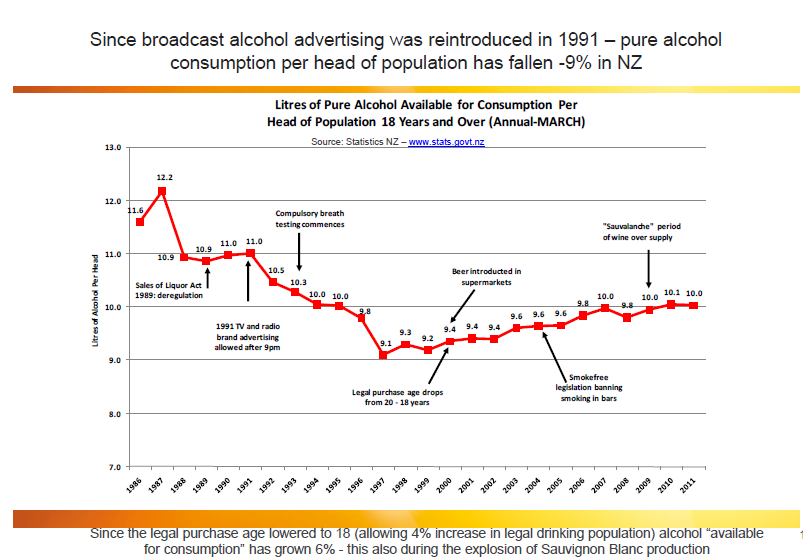
There is no great crisis in aggregate alcohol consumption stats in New Zealand. Via David Farrar:

Per capita consumption is down since alcohol liberalisation in 1989, though slightly up from 1997.

What about problem drinking? Incrementally up among some age groups; incrementally down among others. From the 2010 Ministry of Social Development's Social Report:

Figure H6.1 Potentially hazardous drinking among drinkers, by age, 1996/1997, 2002/2003, 2006/2007

Problem drinking among the 15-24 age group is no different than it was in 1996 prior to the reduction in the legal alcohol purchase age. Things are up a bit for 25-44 year olds and down a bit for 45-54 year olds, though all those differences are really small.

Ah, but what about marginal and worried-over population sub-groups? From the same report:

Table H6.2 Age-standardised potentially hazardous drinking prevalence rate (%), for adult drinkers, by ethnic group and sex, 1996/1997, 2002/2003, 2006/2007
European/OtherMāoriPacific peoplesAsianTotal 15+
1996/1997
Male31.046.148.211.630.9
Female12.030.620.85.113.3
Total21.638.338.19.422.3
2002/2003
Male29.942.444.111.530.6
Female13.324.124.34.814.2
Total21.732.936.18.622.5
2006/2007
Male32.146.846.612.931.2
Female14.528.525.83.814.7
Total23.137.537.78.922.9
Source: Ministry of Health
Notes: (1) Rates are age-standardised using the WHO world population. (2) People who reported more than one ethnic group are counted once in each group reported.

I'm hard pressed to see any there there. If you want to worry tons about the 1.5 percentage point increase in potentially hazardous drinking among Europeans, why not rejoice instead in the similarly trivial percentage point reductions in similar drinking by those from other ethnic groups?

MSD reported we had the 12th lowest level of alcohol consumption in the 30 OECD countries.

Doug Sellman and his ilk ought get honorary doctorates in marketing for their ability to convert the utter absence of evidence of any growing alcohol problem into a moral crisis justifying imposing large costs on moderate drinkers.

In other news, I LOVE how Blogger's new version makes it dead simple for me to paste tables from elsewhere into draft posts.